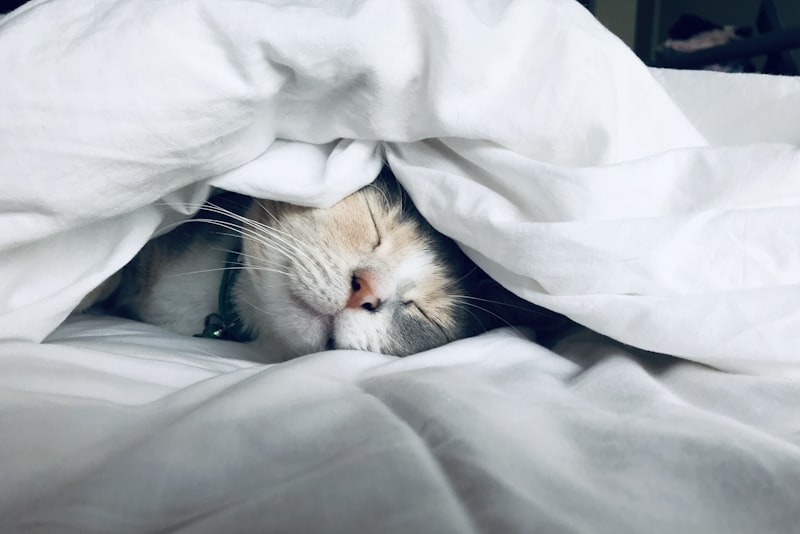
Most people assume they get sleepy simply because they've been awake for a long time. That's half the story. The other half is a clock buried deep in your brain that has been quietly deciding, since before you woke up this morning, roughly when tonight's drowsiness will arrive. Understanding that clock is the single most useful thing I've learned in years of editing sleep science, because once you see how it works, a lot of frustrating sleep problems stop looking mysterious.
Two systems decide when you feel sleepy#
Sleepiness isn't one thing. It's the product of two separate processes running at the same time, and they don't always agree.
The first is sleep pressure. From the moment you wake, a molecule called adenosine builds up in the brain. The longer you're awake, the more it accumulates, and the heavier your eyelids feel. Sleep clears it out. This is the system caffeine temporarily blocks by sitting in adenosine's parking spot.
The second is your circadian rhythm — a roughly 24-hour cycle that raises and lowers your alertness on a schedule, independent of how long you've been awake. It's why you can pull an all-nighter and feel strangely more awake at 6 a.m. than you did at 3 a.m., even though you've been up longer. Your sleep pressure kept climbing, but your circadian system started ramping alertness back up with the approaching day.
You feel genuinely, easily sleepy when both line up: high sleep pressure meeting the downward slope of your circadian alertness. When they fight each other, you get the person lying in bed exhausted but wired, or the one nodding off at 2 p.m. despite a full night's sleep.
Meet the master clock: the SCN#
At the center of the circadian system is a tiny cluster of about 20,000 neurons called the suprachiasmatic nucleus, or SCN. It sits just above where your optic nerves cross, and that location is not an accident.
Left alone in total darkness, the SCN keeps ticking on its own — but its natural cycle in most people runs slightly longer than 24 hours. Left uncorrected, you'd drift later and later every day, like a watch that loses a few minutes daily. Something has to reset it each morning. That something is light.
Why light is the master signal#
Your retina contains special cells — separate from the rods and cones you see with — packed with a pigment called melanopsin. These cells don't care about images. Their entire job is to measure ambient brightness and report it straight to the SCN. They're most sensitive to the blue-heavy light of open daytime sky.
When bright light hits them, the message is unambiguous: it's daytime, sync to now. This is why light is called a zeitgeber, German for "time giver." Meals, exercise, and temperature nudge the clock a little, but light is by far the strongest lever you have.
How timing changes everything#
Here's the part that surprises people: the same light does opposite things depending on when you get it.
- Light in the morning advances your clock — it shifts your natural sleepiness earlier, helping you fall asleep at a reasonable hour and wake more easily.
- Light in the late evening and night delays your clock — it pushes your sleepiness later, so bedtime creeps back and mornings get brutal.
This single mechanism explains an enormous amount of everyday sleep trouble. The person who scrolls their phone in a dark room until 1 a.m. isn't just "distracted" — they're actively telling their SCN that night hasn't started yet. Do that consistently and the clock genuinely relocates.
It also explains jet lag. Fly east and your clock is suddenly running late relative to local time; you need to advance it with morning light. Fly west and you need to delay it. The reason eastward travel usually feels worse is that advancing a clock that naturally wants to run long is simply harder than letting it drift later.
Where melatonin actually fits#
Melatonin is the most misunderstood piece of this whole system. People treat it like a sleeping pill. It isn't one.
As evening light fades, the SCN signals the pineal gland to release melatonin into the bloodstream. Its rise — often called the dim light melatonin onset — is essentially your body's internal announcement that biological night has begun. It's a timing signal, a hormonal way of telling every organ "prepare for night," not a sedative that switches you off.
A few practical consequences follow from that:
- Bright light suppresses it. Those melanopsin cells that reset the clock also shut down melatonin release when they detect light. A bright bathroom at 11 p.m. can blunt the very signal you're waiting for.
- Melatonin supplements work best as a clock-shifter, not a knockout drop. A small dose taken in the early evening can nudge the timing of your rhythm earlier. Taken as a big dose at bedtime purely to "pass out," it disappoints most people — and grogginess from oversized doses is common.
- More is not better. The amounts your body naturally releases are tiny. If you do try a supplement, this is one place where a low dose taken at a consistent time beats a large one, and it's worth talking to a clinician first — I'm describing mechanism here, not prescribing.
The lever most people ignore: your wake time#
If you take one behavioral thing from this article, make it this. When people try to fix their sleep, they obsess over bedtime. But bedtime is largely an output of the system — it's when sleepiness happens to arrive. Wake time is an input you actually control.
A consistent wake time, followed by real light exposure soon after, does two things at once:
- It delivers the morning light signal that anchors the SCN.
- It sets a fixed endpoint, so sleep pressure builds on a predictable schedule and your body learns when night should land.
I've watched this fix more sleep-onset problems than any gadget. Someone who wakes at 6:30 one day and 10:00 the next has essentially given themselves a mild dose of jet lag without leaving the house — the "social jet lag" of sleeping in on weekends. The clock never gets a clean reference point, so evening sleepiness lands at a different time every night.
The honest trade-off: holding a steady wake time on a weekend when you slept badly feels genuinely unpleasant, and no article can make that first hour comfortable. What I tell people is to protect the wake time and get light, then take a short early-afternoon nap if you're wrecked — rather than sleeping in and detonating the whole rhythm.
Putting it to work#
You don't need to memorize the neuroscience to use it. A handful of moves cover most of the benefit.
In the morning#
- Get outside — or at least to a bright window — within an hour of waking. Outdoor light on an overcast day still dwarfs indoor lighting, which is dimmer than people realize.
- Aim for something like 10 minutes on a sunny morning, longer when it's grey. You don't need to stare at anything; ambient exposure is enough.
- Keep your wake time within about an hour across the whole week, weekends included.
In the evening#
- Dim your indoor lights in the last hour or two before bed. Lower and warmer beats bright and blue.
- Treat your phone screen close to your face as a small light source aimed right at those clock-resetting cells. Dimming it and putting it down does more than any single app setting.
- Keep the bedroom genuinely dark. Light in the night doesn't just wake you — it can shove the clock later.
When your schedule breaks#
- Traveling east? Chase morning light at the destination and avoid bright light late.
- Traveling west? Do the opposite — stay up in evening light and go easy on early-morning brightness.
- Shift work is the hard case, and strategic light plus deliberate darkness (blackout curtains, sometimes timed melatonin under medical guidance) is about managing damage, not eliminating it. If your sleepiness feels severe or dangerous, that's a conversation for a doctor, not a curtain purchase.
The bottom line#
Your circadian rhythm isn't a vague wellness concept — it's a physical clock, run by a specific cluster of neurons, set primarily by the light landing on your eyes, and reported to your body through the timing of melatonin. Feeling sleepy at the right hour is what happens when that clock is well-synced and your accumulated sleep pressure arrives to meet it.
The good news is how few levers you actually need to pull: bright light early, dim light late, and a wake time you refuse to negotiate away. Do those consistently for a couple of weeks and you're not fighting your biology anymore — you're finally working with it.